
 By
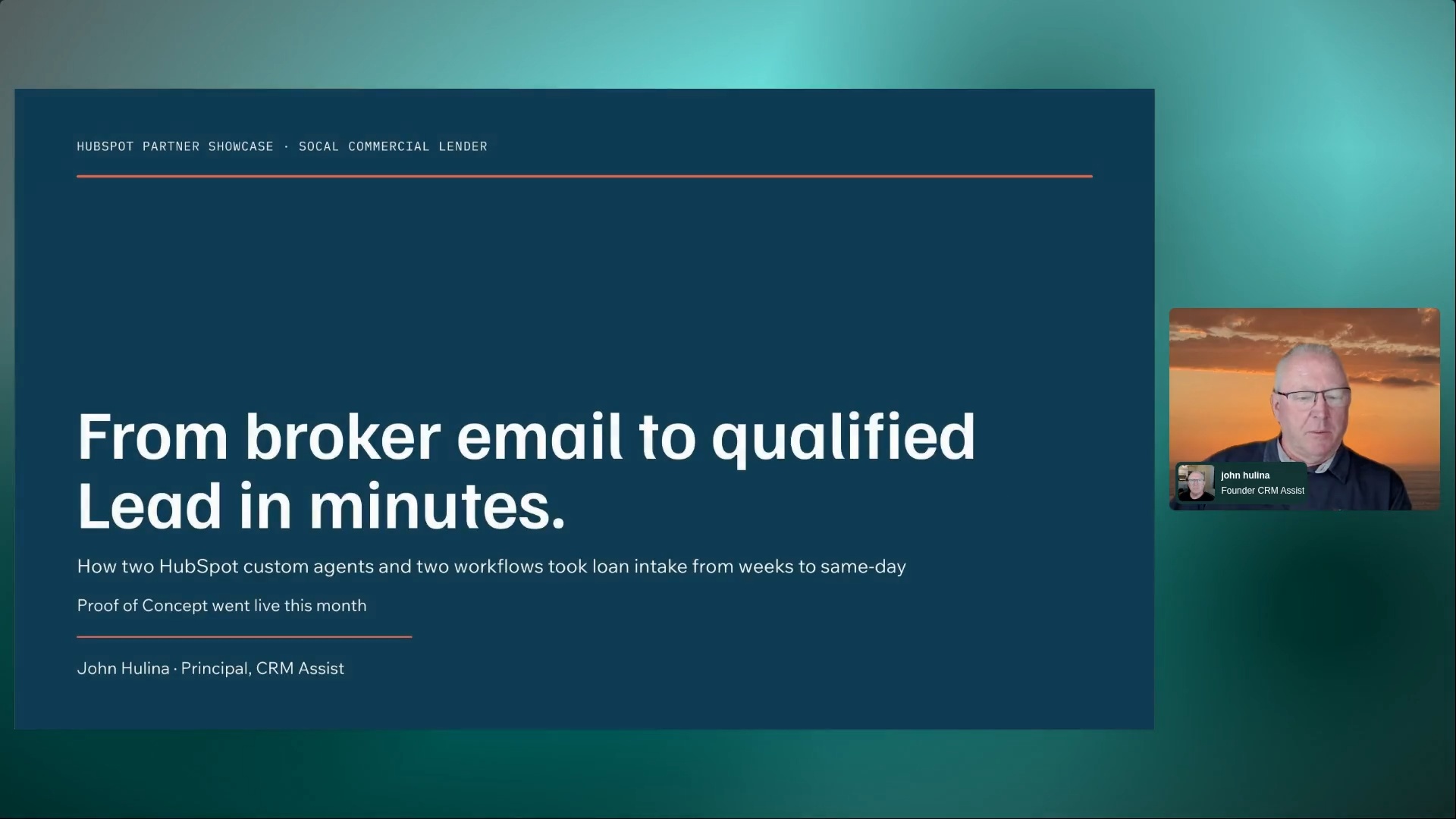
A commercial real estate broker emails a loan officer asking for a bridge quote on a property in Northern California, a couple million dollars. Within minutes, two HubSpot custom agents have read the email, logged the lead, scored it against the lender's criteria, disqualified it, and drafted the decline for the loan officer to send. In this 14-minute walkthrough, I show exactly how that system works and what it took to build.
Watch the walkthrough
Here's the full presentation (about 14 minutes), including a live demo of the intake flow inside HubSpot.
Video not loading? Watch the recording here.
The problem: weeks to answer a broker
The client is a smaller commercial lender in Southern California that receives loan requests from brokers all over the country. Everything was handled by hand, and some brokers waited two to three weeks for an answer.
- Almost 1,300 inbound emails in the previous 30 days
- 39 broker leads disqualified over the prior couple of months
- 10 of those were construction or renovation deals the lender never funds, the easiest possible declines
The goal: every broker email becomes either a qualified lead or a clear decline that teaches the broker what the lender doesn't fund.
Three ground rules
- A person sends every reply. The AI drafts; the loan officer decides and sends.
- The agents don't guess. Broker emails are completely unstructured. If there isn't enough information to score a request, it goes to a "needs more information" bucket instead.
- Free filters come first. HubSpot workflows screen out the noise before any agent spends a credit.
Requirements gathered from what was already in HubSpot
This started as a free proof of concept, because clients struggle to picture what AI can do until they see it. The requirements came entirely from data already in the portal: emails, call transcripts and notes. The lending criteria were deduced from the loan officer's own past decline replies, which let me skip weeks of discovery meetings and build a complete requirements document with no client interviews. That isn't how you'd run a full project, but for a proof of concept it worked. I leaned heavily on Claude and HubSpot Breeze to build the solution. Here's the step-by-step story of how Claude did the build.
How the system works
- Workflow filter (free). Screens out internal emails, replies, auto-replies, newsletters and bounces, and only passes emails from brokers already in HubSpot. Nobody's whole inbox gets scanned.
- Submission Check agent. Decides whether the email is a new loan request or a reply on a loan already in process, checks for duplicates (including multiple brokers pitching the same property), then creates the Lead with a standard name covering borrower, property and location.
- Loan Intake agent. Extracts the loan facts into properties on the Lead and scores it one of three ways: follow up, needs review, or disqualify and decline.
- Tasks, not emails. Every result lands as a task for the loan officer. For declines, the task includes a reply drafted from 11 templates written in the loan officer's own style, ready to paste into the thread and edit.
Results after two weeks
- Response time went from weeks to minutes
- 22 broker leads scored automatically, with zero wrong scores
- 1 met the criteria and moved forward, 8 went to review for missing data, and 13 were disqualified right away
With more than half of incoming requests ending in a decline, the time savings compound quickly.
Keeping credits under control
The first version used 100 to 150 credits per run on the intake agent alone. A leaner scoring design cut that to 43, and the total across both agents dropped from about 230 to about 140 credits per deal. At current volume, the lender is projected to use around 10,000 credits a month. Buying the roughly 7,000 above their included credits costs about $100 a month. During the proof of concept, usage was capped at their free monthly allotment so they couldn't be charged.
Five things to steal for your next build
- Use free workflow filters as much as you can before anything reaches an agent.
- Split the work. Two small agents were far more efficient than one big one.
- Write criteria from the client's real decisions. Past declines and discovery questions in their emails beat weeks of requirements sessions.
- Start with a draft, not an auto-send. Keep a human in the loop.
- Always cap credit usage.
What's next
Two things will turn this into a full product: a third agent to handle the back-and-forth requests for missing information, and moving the lender's manual, email-and-spreadsheet loan processing into HubSpot's new work management tools.
Want something like this in your portal?
If your team is hand-sorting inbound requests, there's probably a version of this that fits your business. Book a consultation with CRM Assist to talk through where an agent would make the biggest difference.